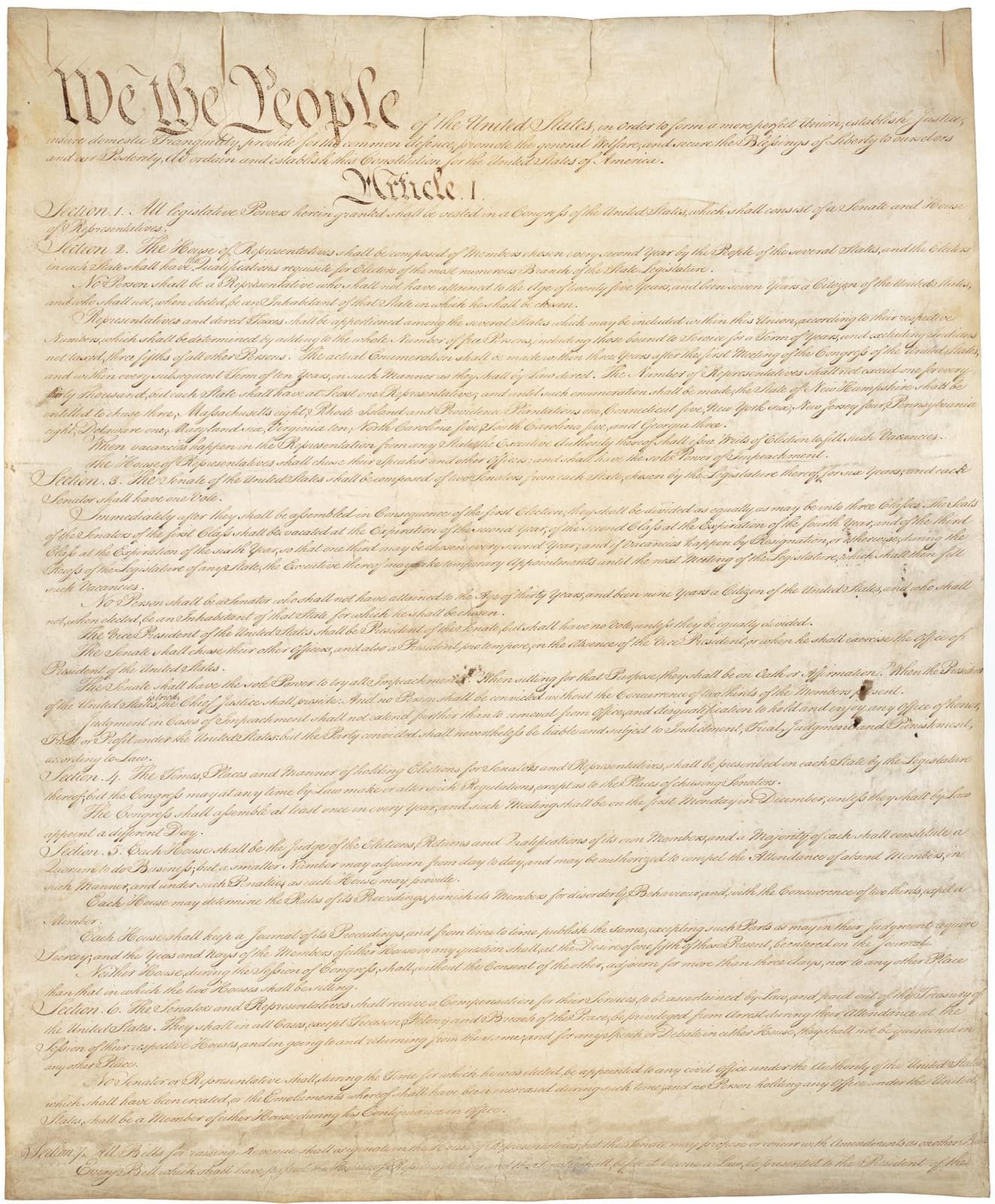
Constitution of the United States, page 1 (engrossed September 17, 1787), National Archives.
Most people assume the genius of the Constitution is its optimism: a hopeful charter for a hopeful new people. It is closer to the opposite. The genius of the Constitution is how little it trusts anyone, including the men who wrote it.
Built to assume the worst
When the delegates gathered in Philadelphia in 1787, their problem was how to give a government enough power to function and enough limits to stay free. Their solution was to divide power and then turn it against itself: power split between the nation and the states, the national government split into three branches, and each branch armed to restrain the others, so that the ambition of one office would be checked by the ambition of the next. It is an ingenious machine, and it runs on a frankly grim assumption about the people who would operate it.
James Madison said the assumption out loud while defending the design: "If men were angels, no government would be necessary." Men are not angels, he went on, and the men who govern are no exception, so the structure was built to assume the worst about whoever would fill its offices and to chain them in advance.

The horizontal check of branch against branch. Federalism, the division of power between the nation and the states, is the other half of the design.
Where that assumption came from
This was not cynicism. It was theology. The founders were building on a view of human nature that Scripture had stated plainly long before Philadelphia.
"The heart is more deceitful than all else And is desperately sick; Who can know it?" (Jeremiah 17:9).
If corruption reaches into every part of every person, as the Christian tradition had always taught, then no one and no office can be safely handed power without a guard on it. A government built to assume the best of its rulers is a government waiting to be betrayed. So the founders feared an unchecked majority exactly as much as they feared a king, because the danger was never really the crown or the crowd. It was the human heart, theirs included, and they knew it. John Calvin had defined the problem two centuries earlier: a "hereditary corruption and depravity of our nature, extending to all the parts of the soul." The whole machinery of checks and balances is one long response to that single fact, an effort to make a safe government out of unsafe materials.
Why it still matters to you
There is a warning folded into this for every generation that inherits the machine. A structure built to restrain sinful rulers still depends on citizens clear-eyed enough to hold them to it. The founders knew the mechanism alone could not save a people who stopped watching. George Washington said as much on his way out of office, naming "religion and morality" as the indispensable supports of the whole experiment. A people who fear no God will eventually fear no law, and no clever arrangement of branches can chain a nation that has decided its rulers are above the rules.
This is the part of the founding most people were never taught, and it is one chapter of a free booklet we wrote for the country's 250th anniversary, Liberty Under God, made for families to read aloud together, honest about the founders' failures and glad in what they got right, with its final hope set on Christ rather than the nation. It is free to read in full, and free to share.
It is also exactly the kind of thinking GraceHaven Academy is built to produce: children who can see the doctrine of human nature underneath a clause of constitutional law, and who understand why a free people has to understand itself before it can govern itself. The Academy's American History course opens the documents and teaches a student to read them this way.
The founders built a government for sinners. The only question each generation answers is whether it still remembers why.
See our new video series that covers this book as well. Liberty Under God | Episode 2: The Road to Independence — How Loyal Colonists Chose 1776