Most science curricula present themselves as neutral. Just the facts, the textbook implies. Just observation, measurement and the conclusions any reasonable person would draw.
That posture is the first thing your child should learn to question. Not because science is untrustworthy, but because no one approaches the evidence without assumptions. The textbook that claims neutrality is the one most likely to smuggle its starting points past a student who was never taught to look for them.
A child who can name the assumptions behind a claim is doing science. A child who absorbs the conclusions without seeing the assumptions is only memorizing.
Two Kinds of Science
There is a distinction most curricula never make, and it changes how a student reads everything that follows.
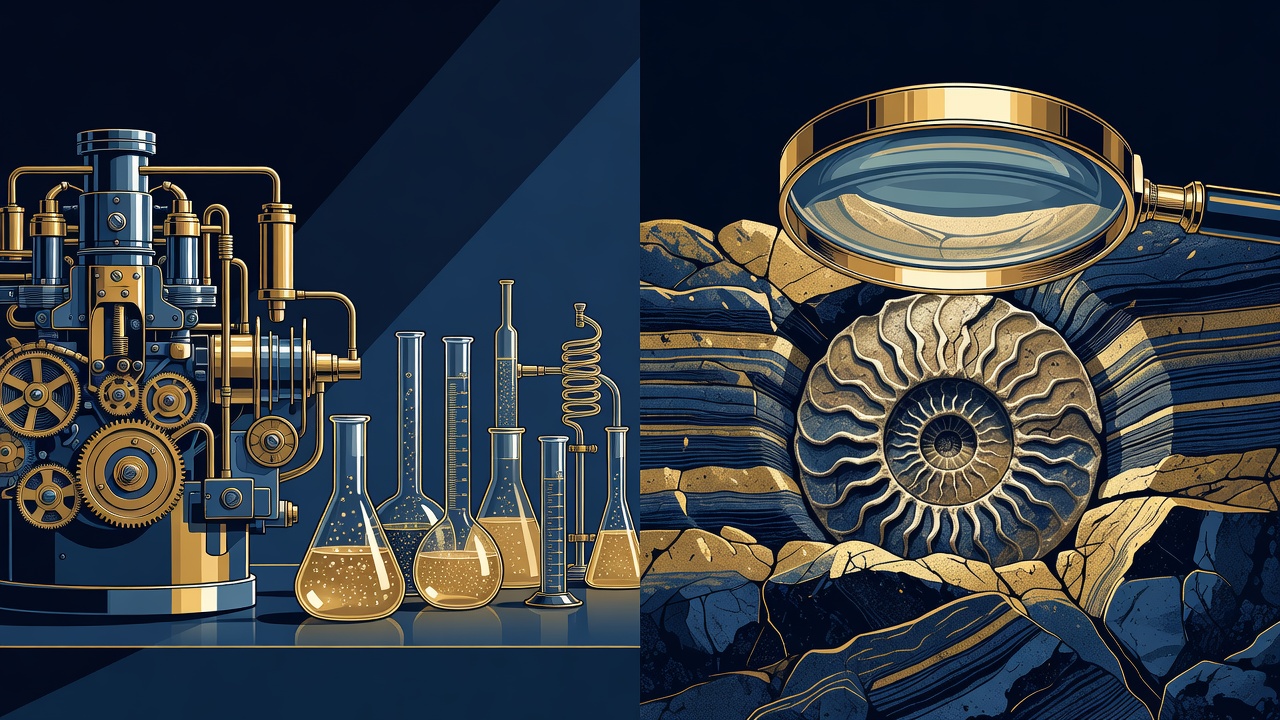
Operational science is the science of the repeatable and the observable. It builds engines, cures diseases and sends instruments to the edge of the solar system. You can test it, repeat it and watch it work in the present. When people speak of science delivering reliable results, this is usually what they mean.
Historical science is different. It reconstructs unobserved events from present evidence. No one watched the distant past happen, so the historical scientist reasons backward from what remains. This is legitimate work, but it carries a different kind of certainty. The same rock layer, the same fossil, the same distant light can yield different conclusions depending on the assumptions a scientist brings to it.
This is not a Christian objection to science. It is a description of how science actually works. A student who understands the difference between watching an engine run and reconstructing an unwitnessed past will read every documentary and textbook with sharper eyes.
The Assumptions Underneath
When a curriculum presents the deep past, it is doing historical science, and historical science always rests on a framework. The question is never whether a framework is present. The question is which one, and whether the student can see it.
A curriculum built on the assumption that natural processes alone, given enough time, account for everything will read the evidence one way. A curriculum built on the conviction that God created an ordered world, that the order we observe reflects a Maker and that the biblical account is reliable history will read the same evidence differently.
Both are doing science. Both are interpreting. The difference is that one of them admits its starting point.
Order Is Not an Accident
There is a reason science is possible at all, and most textbooks step right over it.
Science depends on the natural world behaving consistently. The same experiment yields the same result. Matter obeys the same laws today as yesterday. Light travels at a fixed speed. The universe is intelligible, and the human mind is capable of grasping it.
Every scientist assumes that order before he takes a single measurement. He cannot prove it from inside the experiment. It has to be granted before the work begins.
The Christian knows why it is there. An orderly God made an orderly world and gave men minds able to read it. And the closer a student looks, the harder that becomes to shrug at. The constants of physics are balanced on a knife edge, instructions are written in code inside every living cell and mathematics invented in the mind describes a universe that never asked its permission. Only a God of infinite wisdom and power designs like that.
We do not say this from a defensive crouch, as though the case had to be won before a child is allowed to learn chemistry. We say it because it is the plainest thing in the room. A science teacher who cannot say it is asking a student to admire the workmanship and never mention the Workman.
Rightly studied, science is the study of God. A student who learns to see the order, and to ask where it came from, is not being handed an argument. He is being handed his eyes.
Teaching the Student to See
The goal is not to hand a child the right conclusions. The goal is to teach the child to see the assumptions in any claim, to distinguish what is observed from what is inferred and to recognize that the order of creation points beyond itself.
That is harder than memorizing the parts of a cell. It is also the difference between a student who can be told anything and a student who can think.
This is how GraceHaven Academy teaches science. Genesis as the governing framework, stated rather than smuggled. The operational and historical distinction made plain from the beginning. Observation and inference kept clearly apart, so a student always knows which one he is being handed.