Every few years, someone writes an article asking whether Latin still belongs in the curriculum. The answer has not changed in five hundred years: yes.
But the reasons are not what most people think. Latin is not valuable because it is old. It is not a badge of rigor or a nod to tradition. Latin is valuable because of what it does to the mind of the student who learns it.
Latin Teaches Grammar in a Way English Cannot
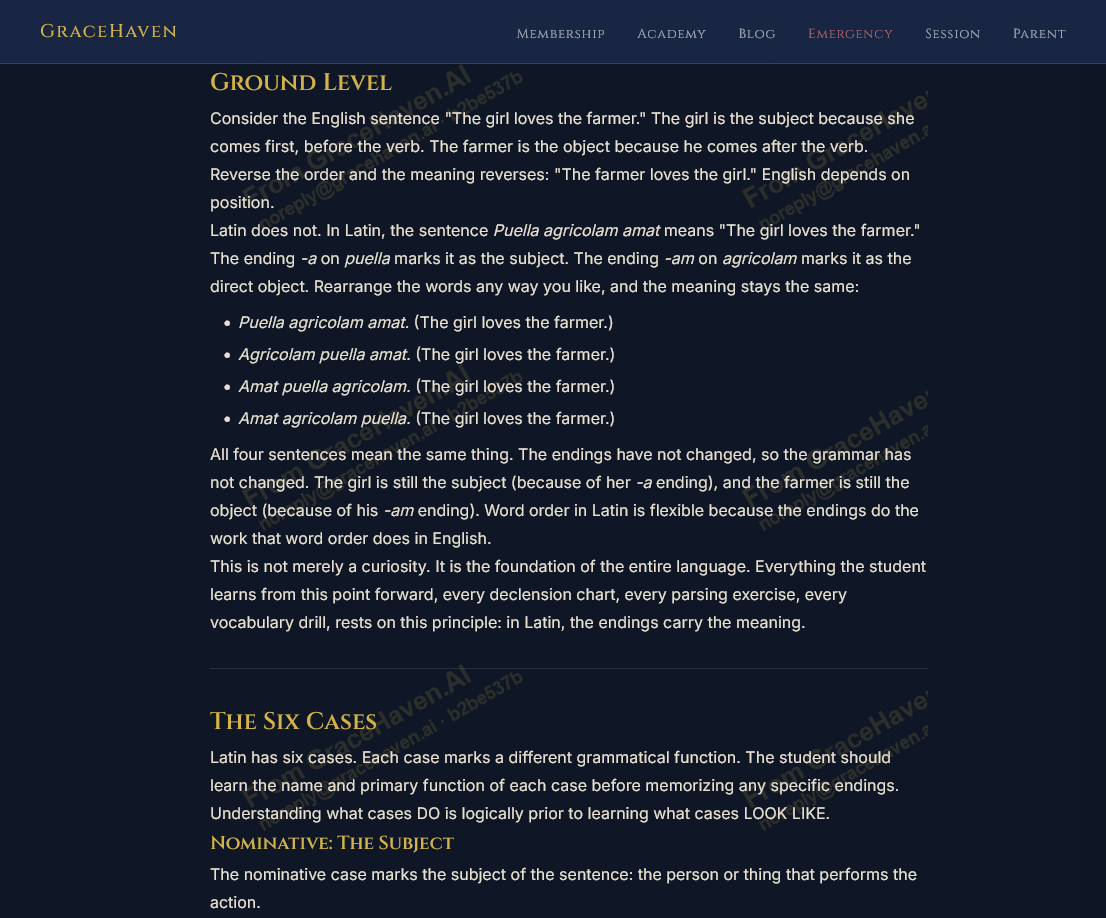
English has shed most of its inflectional system. We rely on word order to convey meaning. "The dog bit the man" and "The man bit the dog" use the same words, and only order tells you who did the biting.
Latin does not work this way. In Latin, the form of the word itself tells you its function in the sentence. The subject looks different from the object, regardless of where they appear. This means a student learning Latin must identify the role of every word by examining the word itself. They cannot lean on word order as a crutch.
This trains a kind of attention to language that carries over into everything the student reads and writes afterward, in any language. Students who have studied Latin consistently demonstrate stronger reading comprehension, more precise writing, and better grammatical instincts than students who have not. This is not tradition talking. It is data.
Latin Opens the Vocabulary of Every Serious Subject
Over 60% of English words derive from Latin, and in technical and academic fields the percentage is higher. A student who knows Latin roots does not memorize vocabulary. They decode it.
"Cardiovascular" is not an intimidating term if you know that cor means heart and vasculum means small vessel. "Jurisprudence" is transparent if you know ius means law and prudentia means wisdom. "Benevolent" unpacks itself: bene (well) + volens (wishing).
This is not a party trick. It is a genuine academic advantage that compounds over years of study. The student with Latin never hits a wall of unfamiliar terminology in science, law, medicine, theology, or philosophy. They already have the keys.
Latin Connects Your Child to the Western Tradition

For over a thousand years, Latin was the language of scholarship, law, theology, and diplomacy in the Western world. Augustine, Aquinas, Calvin, and Luther all wrote in Latin. The great confessions of the Reformation were drafted in Latin. The scientific revolution was published in Latin.
A student who reads even basic Latin has access to this tradition in a way that a student dependent on translations does not. They do not need to become fluent. Even a working knowledge of Latin grammar and vocabulary opens doors that would otherwise remain closed.
Latin Prepares the Way for Greek and Hebrew
For families who want their children to eventually study the biblical languages, Latin is the ideal first step. Latin grammar introduces concepts, such as case, mood, tense, and voice, that appear in both Greek and Hebrew. A student who has already learned to parse Latin verbs and decline Latin nouns will find any other language far more accessible than a student starting from zero.
This is one reason the classical tradition has always placed Latin first in the language sequence. It is not arbitrary. It is pedagogically sound.
The Objection
The most common objection is that Latin is "dead," meaning no one speaks it natively. This is true and irrelevant. No one studies Latin to order coffee in Rome. They study it because it trains the mind, unlocks vocabulary, connects them to their intellectual heritage, and prepares them for further language study. On every one of those counts, it delivers.
Available Now
GraceHaven Academy includes a Latin curriculum as part of its classical sequence. It teaches Latin not as an artifact but as a living tool: rigorous in grammar, rich in its connection to the Western and Christian traditions, and designed to prepare students for further language study. You can explore the curriculum and enroll as a founding family at gracehaven.ai/academy.