Consider two students.
The first has been told that she should drink eight glasses of water a day. She can repeat the rule. She can tell you how often she has heard it. But if you ask her to lay out the argument for it, to identify its premises and judge whether the conclusion actually follows, she cannot. She holds the rule because she has heard it so many times.
The second student has heard the same rule. But she has also been taught to examine the form of an argument apart from its content. She can tell the difference between "everyone says so" (an appeal to popularity) and "here is the evidence, and here is why it supports the claim" (an empirical argument). She can weigh each on its own terms. She knows the first is weaker than the second, whatever the topic.
The difference between these two students is not intelligence. It is training. The second student has studied logic.
What Logic Actually Is
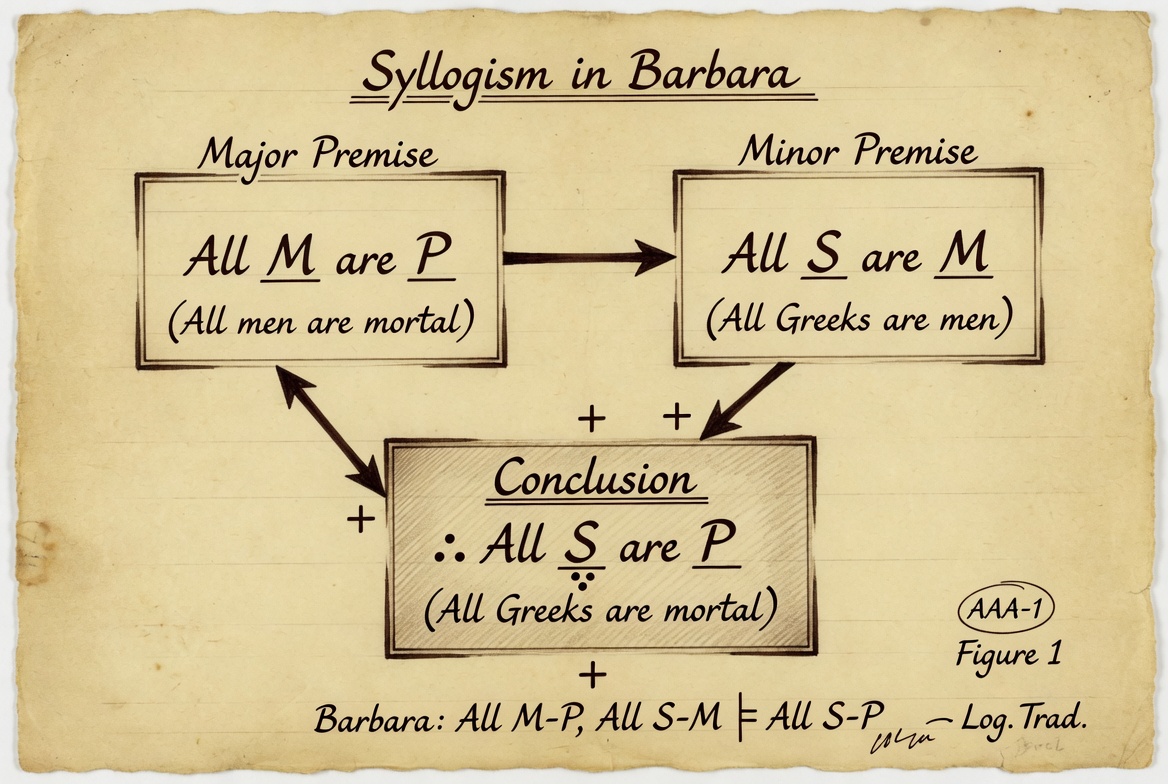
Logic is the study of valid reasoning. It examines the structure of arguments to determine whether conclusions follow from premises, independent of whether the premises are true.
This distinction is critical. An argument can be valid (the conclusion follows from the premises) without being sound (the premises are actually true). A student who understands this distinction has a tool that works in every domain: science, politics, theology, daily conversation.
Consider this argument:
- All birds can fly.
- Penguins are birds.
- Therefore, penguins can fly.
The argument is valid. The conclusion follows logically from the premises. But it is not sound, because the first premise is false. Not all birds can fly.
A child who can make this distinction will never be fooled by an argument that sounds right but starts from a false assumption. That skill is worth more than a hundred memorized facts.
Why Schools Skip It
For some reason, logic is rarely taught in classrooms anymore. For centuries, it was considered foundational, the second stage of the trivium, taught after grammar and before rhetoric. You learned facts, then you learned to reason about them, then you learned to communicate your reasoning.
The modern educational model largely skipped the middle step. Students absorb information and then are asked to express opinions about it. The reasoning step, the part where they learn to evaluate whether an argument actually holds together, is assumed rather than taught.
This results strong opinions and weak arguments. They know what they believe but cannot explain why their beliefs are rational. They can detect conclusions they disagree with but cannot identify the specific point where an argument fails.
What Logic Training Looks Like
Formal logic begins with the basics: terms, propositions, and syllogisms. A student learns that an argument is not just "a disagreement." It is a set of propositions arranged so that one (the conclusion) is claimed to follow from the others (the premises).
They learn to identify common valid forms:
- If A, then B. A is true. Therefore, B is true. (Modus ponens)
- If A, then B. B is false. Therefore, A is false. (Modus tollens)
They learn to identify common fallacies:
- Affirming the consequent: If A, then B. B is true. Therefore, A is true. (Invalid.)
- Ad hominem: Attacking the person making the argument rather than the argument itself.
- Equivocation: Using the same word with two different meanings in the same argument.
Once a student can identify these patterns, they see them everywhere. In news articles. In political speeches. In advertising. In conversations with friends. The world becomes more transparent.
Why This Matters for Christian Families

Christian faith is not opposed to reason. Scripture commands us to love God with all our mind (Matthew 22:37). Peter instructs believers to be prepared to give a reason for the hope that is in them (1 Peter 3:15). Paul reasoned with Jews and Greeks alike in the synagogues and marketplaces (Acts 17).
A child trained in logic is better equipped to understand theological arguments, evaluate competing interpretations of Scripture, and give an honest, rigorous defense of their faith. They will not be shaken by a clever-sounding objection, because they will know how to examine whether the objection actually holds together.
This is not about winning debates. It is about building the kind of mind that can pursue truth carefully and communicate it clearly.
Available Now
GraceHaven Academy includes a logic curriculum as part of its classical sequence. It covers formal and informal logic, categorical syllogisms, propositional logic, and common fallacies, all taught through real examples and Socratic engagement rather than rote memorization. You can explore the curriculum and enroll as a founding family at GraceHaven.ai/Academy.