There is a quiet crisis in how Christians teach the Bible to their children. Most curricula mean well. They want children to love Scripture. But the methods they use often accomplish the opposite.
The Problem
Walk into most Christian education settings and you will find one of two approaches to Bible teaching.
The first is the moral lesson approach. Every passage is mined for a takeaway. David and Goliath teaches courage. Daniel in the lion's den teaches faithfulness. Jonah teaches obedience. The child learns that the Bible is a collection of stories with morals, like Aesop's fables with a Christian coat of paint.
The second is the theological download approach. The teacher has conclusions. The curriculum has answers. The student's job is to absorb them. By the end of the year, the child can fill in the blanks on a worksheet: "God is ________." "Jesus died for our ________." "We are saved by ________."
Both approaches fail for the same reason. They stand between the child and the text.
What Scripture Actually Does
Scripture is not a delivery mechanism for moral lessons. It is the self-revelation of God. When God wanted to make Himself known, He did not hand down a systematic theology textbook. He gave us narrative, poetry, prophecy, law, wisdom literature, epistles, and apocalyptic vision. He gave us a library.
The diversity of that library is not a problem to be solved. It is the point. God reveals different facets of His character through different kinds of writing. The narrative books show Him acting in history. The Psalms show what it looks like to bring honest human emotion before a holy God. The prophets show His justice and His relentless pursuit of a wayward people. The epistles show the implications of the gospel for everyday life.
A child who learns to read each genre on its own terms will see more of God than a child who reduces every passage to the same three-point moral lesson.
Letting the Text Speak
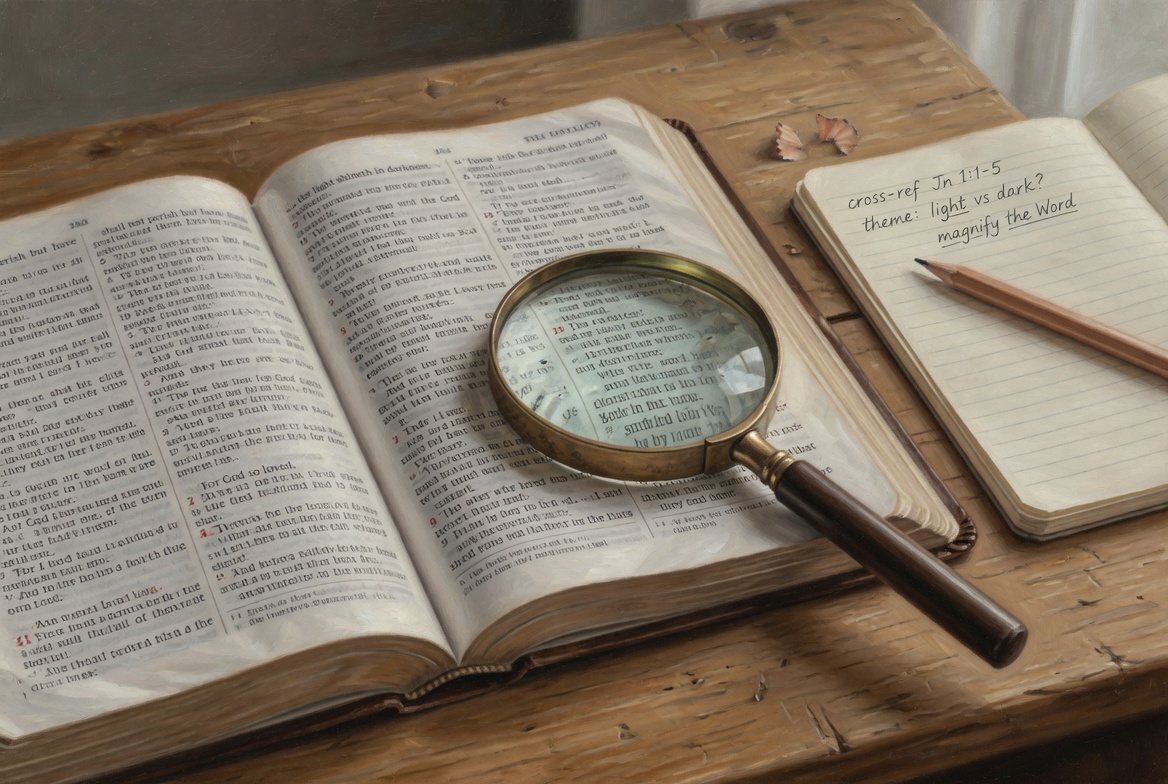
The most important skill in Bible study is also the most neglected: observation. Before you ask "What does this mean?" you must ask "What does this say?"
This sounds obvious, but it is rarely practiced. Most students jump straight from reading a passage to interpreting it. They skip the step where they slow down and notice what is actually on the page. Who is speaking? To whom? What words are repeated? What is surprising? What questions does the text raise that it does not immediately answer?
A child who has been trained to observe before interpreting will notice things that a child looking for the moral of the story will miss entirely. They will notice that when God speaks to Job out of the whirlwind, He never answers Job's question. They will notice that the Psalms include prayers that express anger at God, and that God included those prayers in His Word on purpose. They will notice that Paul's letters are not timeless advice columns but responses to specific situations in specific churches, and that understanding the situation changes how you read the response.
The Difference This Makes
A child trained this way does not need someone standing between them and the text, filtering it into predigested lessons. They can open Scripture and read it carefully on their own. They know how to handle narrative differently from poetry. They know to look for context before jumping to application. They know that the first question is always "What is God revealing about Himself here?" not "What should I do?"
This is not a skill that comes naturally. It must be taught. But once taught, it lasts a lifetime. A twenty-year-old who was trained to read Scripture carefully at twelve will still be reading it carefully at forty.
Available Now
GraceHaven Academy includes a Bible Survey curriculum that teaches children to read Scripture this way. It covers the entire Bible, Old Testament and New, not as a collection of moral stories but as the unified self-revelation of God. It teaches observation, context, and genre. It trusts the text to do its own work. You can explore the curriculum and enroll as a founding family at GraceHaven.ai/Academy.
Because the Bible does not need your help. It needs your attention.