Chapter Five: What They Built
Winning independence was one problem. Governing a free people without sliding back into either chaos or tyranny was a harder one, and the first attempt failed. What the founders built on the second attempt, the Constitution, is the most thoughtful frame of government any nation has ever written down, and it was built on a clear-eyed and frankly biblical view of what human beings are. To understand it is to understand the seed the founders planted, a seed that is still meant to grow in the citizens who live under it.
A government too weak, then a government well made
The first national government, under the Articles of Confederation, was deliberately feeble, for a people who had just fought a long war to throw off an overbearing power were in no mood to raise up a strong one of their own. So they built a government that could barely govern. It could not tax, could not regulate trade among the states, and could not enforce its own decisions. The states behaved like thirteen small countries, printing their own money and taxing one another's goods, and thoughtful men began to fear that the liberty so dearly bought was dissolving into disorder.
Then came a warning that could not be ignored. Debt-burdened farmers in western Massachusetts, many of them veterans of the Revolution facing the loss of their farms, rose in armed revolt and shut down the courts, and the national government had no force of its own to send against them. The shock traveled through every state. A government too weak to keep order, men realized, is as dangerous to liberty as one too strong, because where lawful authority cannot act, disorder fills the gap, and frightened people have always been willing to trade their freedom for the promise of order.
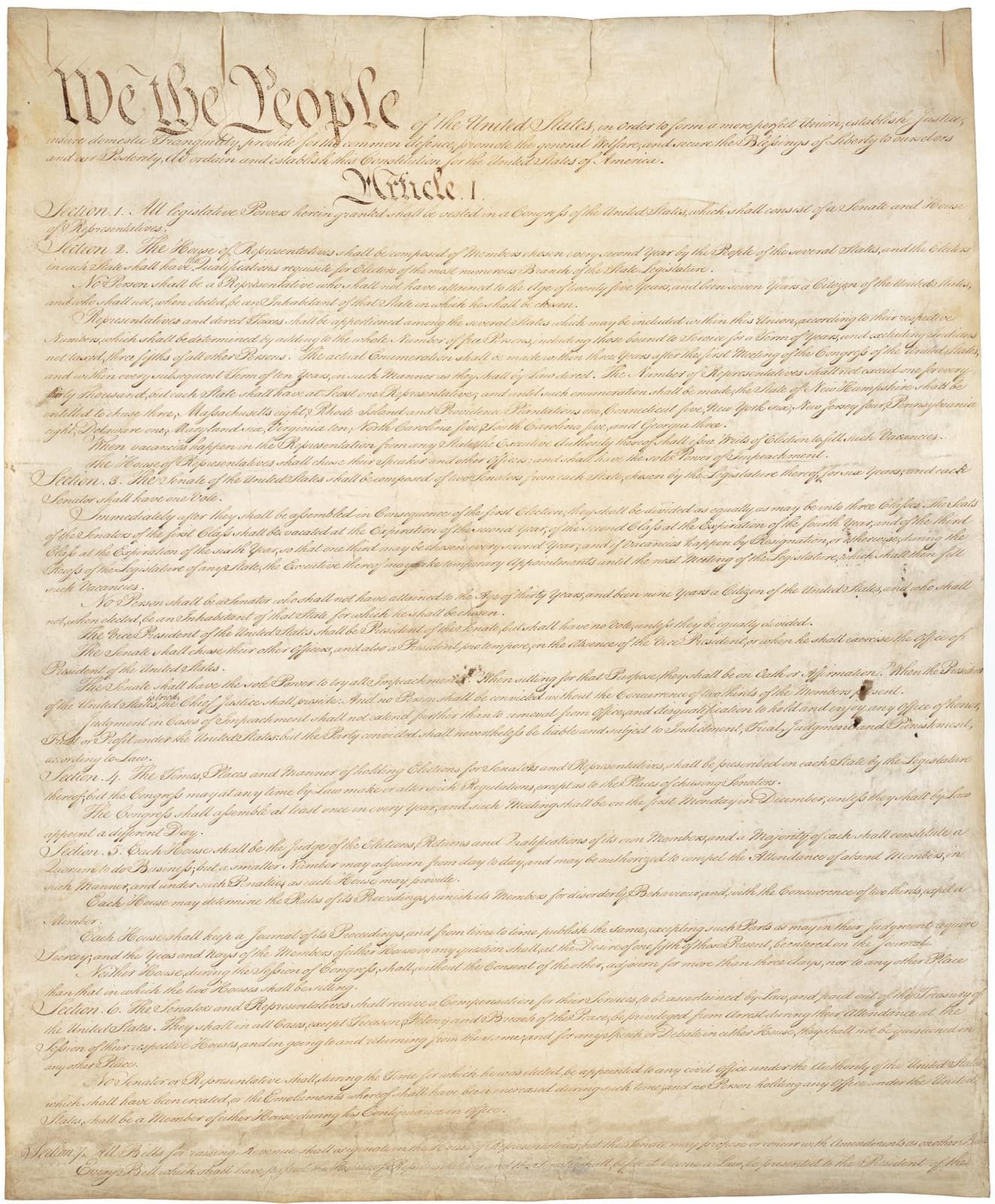
Constitution of the United States, page 1 (engrossed September 17, 1787), National Archives
So in the summer of 1787 delegates gathered in Philadelphia, shut the windows against eavesdroppers and the heat, and built a new government from the foundation up. Their central problem was how to give it enough power to function and enough limits to stay free. Their answers were three, and they work together. Federalism divided power between the nation and the states, so that no single government held all of it. The separation of powers split the national government into three branches, each with its own work. And a system of checks and balances armed each branch to restrain the others, so that the ambition of one office would be set against the ambition of the next.

The horizontal check of branch against branch. Federalism, the division of power between the nation and the states, is the other half of the design.
Why they feared a crowd as much as a king
Here is the part most people have never been taught, and it is at the heart of what the founders built. The power they feared most wore two faces, and they guarded against both. One was the old danger they had just fought a war over, a king or any single ruler holding power without account. The other was newer and harder to say aloud in a country that had just appealed to the people against a crown: the danger of an unchecked majority, a temporary popular passion turned against a minority with no law standing in its way.
For this reason the founders did not build a pure democracy, where the assembled people decide every question by a raw count of hands. They built a republic, where the people govern through elected representatives and under a written law that stands above the wish of any momentary majority. This was a deliberate choice, not an accident, and the founders said so plainly. They had studied the direct democracies of the ancient world and did not like how they ended. John Adams put the worry bluntly: "Democracy never lasts long. It soon wastes exhausts and murders itself. There never was a Democracy Yet, that did not commit suicide."1 When the convention finished its work and a citizen asked Benjamin Franklin what kind of government they had given the country, the answer that has come down to us was a warning as much as a description: a republic, if you can keep it.2
The Constitution wrote the choice into its own text, guaranteeing to every state "a Republican Form of Government," and building a Senate where every state stands equal so that sheer numbers would not carry every question.3 The founders bounded the power of the majority for exactly the same reason they bounded the power of a king. They did not trust unchecked power in anyone's hands, the people's included, because they did not trust the human heart, their own included.
"The heart is more deceitful than all else And is desperately sick; Who can know it?" (Jeremiah 17:9).
James Madison said the same thing in plainer political words when he defended the new design: "If men were angels, no government would be necessary."4 Men are not angels, and the men who govern are no exception, so the structure was built to assume the worst about the people who would fill its offices and to chain them in advance. The whole machine is not arbitrary cleverness. It is a response to the Fall, an effort to make a safe government out of unsafe materials.
The seed: a law above the rulers
Scripture had taught the deepest principle of the Constitution long before Philadelphia. Even Israel's king, the highest power in the land, was commanded to live under a written law he had not made and could not revise.
"And it shall be with him, and he shall read it all the days of his life, that he may learn to fear Yahweh his God, to carefully observe all the words of this law and these statutes," (Deuteronomy 17:19).
The danger the passage names is exactly the danger the founders feared, a ruler whose heart is lifted up above the people he governs, who comes to believe the law is beneath him. A constitution that places every official, the president as fully as the humblest clerk, under a written law none of them can escape is built on that very idea. And notice that this does not despise authority. Scripture affirms that governing authority comes from God and is to be honored. The founders did not reject authority. They bounded it. Power is real and God-given, and precisely because it answers to God it must never be made absolute in the hands of men.
Three convictions are planted here, like seeds, and they are worth saying simply, because a free people has to keep them alive on its own. The first is that legitimate law is not whatever the powerful decide it is; it derives from a higher authority, the law of nature and of nature's God, and a command that breaks that higher law has no true authority however official it looks. The second is that those who hold office are bound under the supreme law, not standing above it, and the day they treat the law as theirs to remake at will is the day the chain has slipped. The third is the oldest and the most easily forgotten: a free government cannot run on machinery alone. It needs citizens who are virtuous and watchful, who know what the law is meant to do and will hold their own rulers to it.
"When the righteous increase, the people are glad, But when a wicked man rules, people groan." (Proverbs 29:2).
A people will sometimes be governed by the righteous and sometimes by the wicked, and no constitution can guarantee which. What a good constitution can do is limit the harm a wicked ruler may inflict and order the good a righteous one accomplishes. That is precisely what this one set out to do, and it has outlasted every other written national constitution on earth.
One liberty the new structure secured deserves special notice, because it healed a wound the colonies had carried from their first generation. The Pilgrims and Puritans had crossed an ocean for freedom of conscience and then, once they held power, denied that same freedom to the dissenters among them. The founding corrected the failure. The First Amendment forbade Congress to establish a national church or to prohibit the free exercise of religion, and so the conscience the Puritans had claimed only for themselves was secured, in the nation's supreme law, for everyone. A government barred from dictating a man's worship had finally learned the lesson conscience had been teaching since Plymouth: that the soul answers to God, and the state must not stand between them.
The man who gave the power back
A constitution on paper is only a hope until someone proves it can work, and the first proof was George Washington. Almost everything he did set a precedent, because there was nothing before him. The most remarkable thing he did was the simplest: a general who had commanded a victorious army, and then a president who could likely have held office for life, gave the power back. He served and then went home. Set that against the long record of history, where victorious generals seize power and keep it, and Washington stands out sharply. He was no flawless hero, and it would dishonor the truth to make him one. He held more than a hundred men, women, and children in slavery on the very estate to which he so famously retired, and the freedom he secured for his countrymen he did not extend to them, though he came at the last to trouble over it and ordered them freed in his will. What can be honored without flattery is not the whole man but the precise thing he did with power, which was to let it go.
As he left office he warned the country, in a farewell address read aloud for generations, about the deepest support of the whole experiment. "Of all the dispositions and habits which lead to political prosperity," he wrote, "religion and morality are indispensable supports."5 He was naming what the founders generally believed but did not always say plainly: free government cannot sustain itself on mechanism alone. A people who fear no God will eventually fear no law. The ordered liberty the Constitution built rests, in the end, on a moral foundation its architects knew they could not manufacture themselves, and could only hope each new generation would receive.
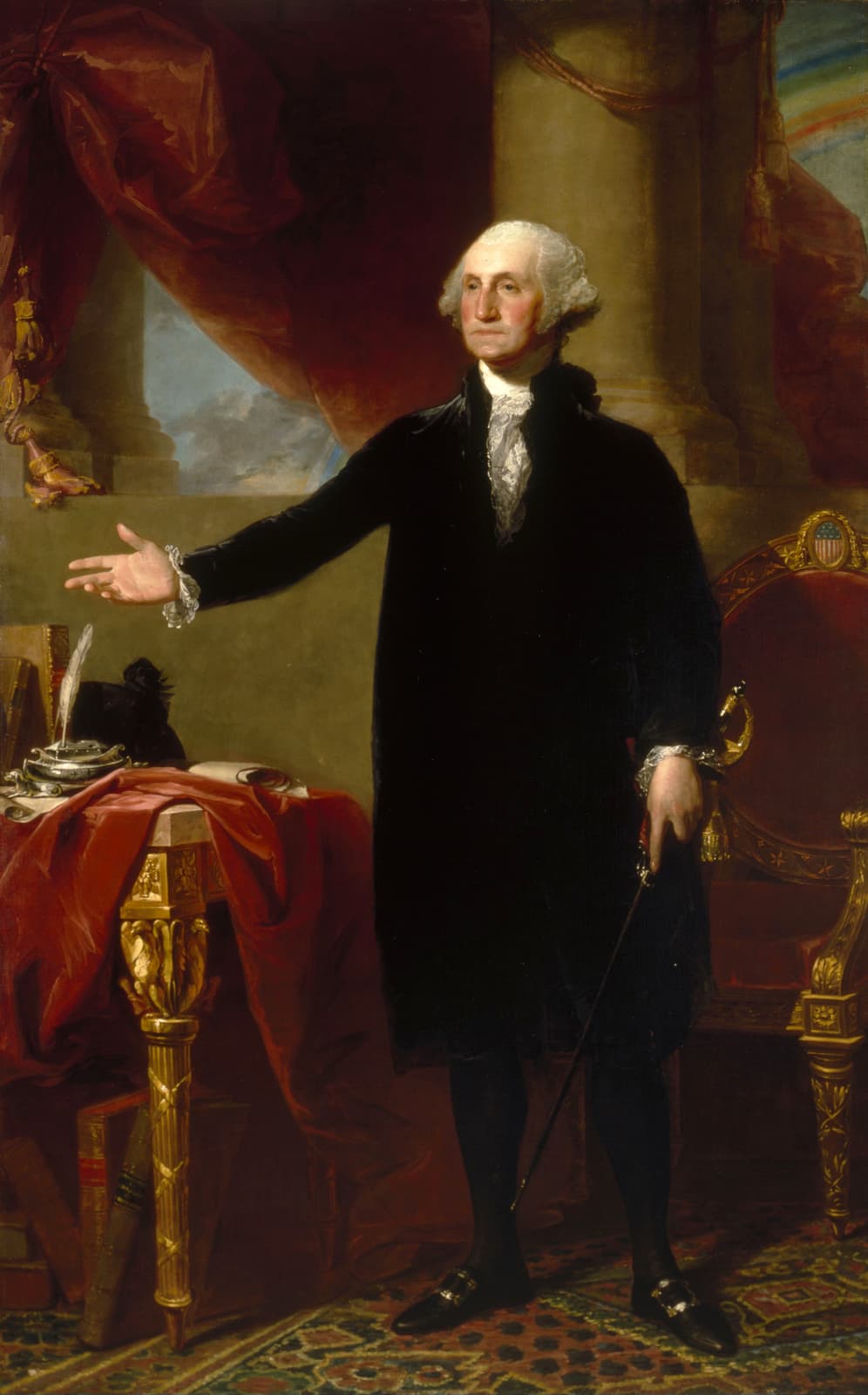
Gilbert Stuart, George Washington, Lansdowne Portrait (1796)
For Reflection
"Original sin, then, may be defined a hereditary corruption and depravity of our nature, extending to all the parts of the soul, which first makes us obnoxious to the wrath of God, and then produces in us works which in Scripture are termed works of the flesh."
John Calvin, Institutes of the Christian Religion6
This is the conviction beneath the whole machinery of checks and balances. If corruption reaches every part of every person, then no one and no office can be safely trusted with power left unguarded, and a government built to assume the best of its rulers is a government waiting to be betrayed. The framers built for the truth Scripture had stated plainly since the days of Noah.
"Then Yahweh saw that the evil of man was great on the earth, and that every intent of the thoughts of his heart was only evil continually." (Genesis 6:5).
Hymn
Lo, God Is Here! Let Us Adore
Gerhard Tersteegen (1697-1769), a German pietist, wrote this hymn in German in 1729 as a call to worshipping awe before the living God. John Wesley (1703-1791) translated it into English for his Hymns and Sacred Poems (1739). A chapter on a government built by men who feared the fallen heart, their own included, closes fittingly on a hymn that bows the heart low before the One under whom all authority stands. The German tune VATER UNSER carries the weight of the text with fitting gravity.7
Lo, God is here! let us adore,
And own how dreadful is this place;
Let all within us feel His power,
And silent bow before His face;
Who know His power, His grace who prove,
Serve Him with awe, with reverence love.Lo, God is here! Him day and night
United choirs of angels sing;
To Him, enthroned above all height,
Heaven's host their noblest praises bring;
Disdain not, Lord, our meaner song,
Who praise Thee with a stammering tongue.Being of beings, may our praise
Thy courts with grateful fragrance fill;
Still may we stand before Thy face,
Still hear and do Thy sovereign will;
To Thee may all our thoughts arise,
Ceaseless, accepted sacrifice.In Thee we move; all things of Thee
Are full, Thou Source and Life of all;
Thy wisdom, power, and majesty
Through all created being call;
Shall creature then with creature vie
In praise of Thee, most High?
Footnotes
-
John Adams to John Taylor, 17 December 1814, Founders Online, National Archives. ↩
-
The remark is recorded in the papers of James McHenry, a delegate to the Constitutional Convention, as Franklin's reply at the close of the Convention (1787). Its authenticity is debated, and it is given here as a received anecdote rather than a documented quotation. ↩
-
U.S. Constitution, art. IV, sec. 4. (Available in the GraceHaven library.) ↩
-
James Madison, The Federalist No. 51 (1788). (Available in the GraceHaven library.) ↩
-
George Washington, Farewell Address (19 September 1796). (Available in the GraceHaven library.) ↩
-
John Calvin, Institutes of the Christian Religion, trans. Henry Beveridge (Edinburgh: Calvin Translation Society, 1845), 2.1.8. (Available in the GraceHaven library.) ↩
-
Gerhard Tersteegen, "Lo, God Is Here! Let Us Adore" (1729), trans. John Wesley, in Hymns and Sacred Poems (1739); tune VATER UNSER. ↩